Why Do Cats Purr? 2026 Vet-Approved Guide
Why do cats purr? Beyond contentment, purring is a 25-150 Hz self-healing frequency. Learn the 7 reasons cats purr, the solicitation purr hack, and when purring signals something's wrong.
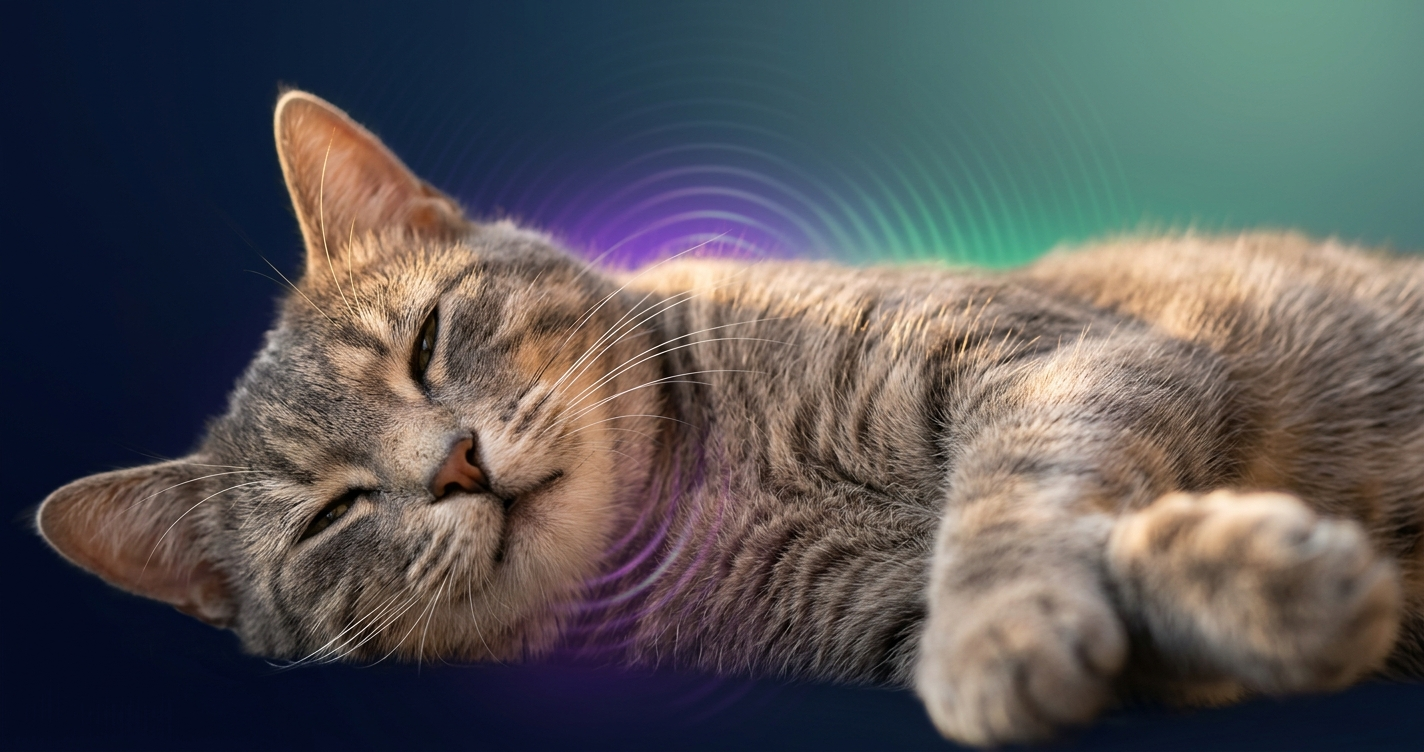
Your cat settles onto your chest, closes their eyes, and starts that familiar low rumble. You can hear it, you can feel it, and if you are the kind of person who reads vet research at 11 p.m., you have probably wondered what is actually happening inside that cat's body. Why do cats purr in the first place?
The short answer is that purring is not just a sound — it is a 25 to 150 Hz vibration produced by the larynx that serves multiple jobs at once: communication, self-soothing, and, according to decades of bioacoustics research, physical healing. And unlike a meow, which cats use almost exclusively to talk to humans, purring is genuinely ancient. Kittens purr within days of birth, before they can see, hear, or regulate their own body temperature. So it is wired deep.
This is a vet-informed 2026 guide to what the research actually shows about why cats purr, when purring is a good sign, and when it is a clue something else is going on. Purring is part of a broader story about how cats perceive and interact with their environment — sensory, instinctive, and built for survival first, humans second.
How Cats Actually Produce a Purr
For decades the mechanism was debated. We now know that purring is driven by a neural oscillator — a rhythmic signal generator in the cat's brain — that tells the laryngeal muscles to open and close the glottis 25 to 150 times per second. Air passes through the vibrating glottis on both the inhale and the exhale, which is why a purring cat sounds continuous rather than starting and stopping with each breath. Most other cat vocalizations (meow, chirp, hiss) are one-way — air moving out. Purring is the unusual case.
A 2023 paper in Current Biology added another piece. Researchers at the University of Vienna found that cats also have small pads of connective tissue near the vocal folds that help them produce very low-frequency sound without needing active brain input on every cycle. That means the body itself can sustain a purr partly on autopilot — useful if the cat is injured, sick, or too relaxed to do much. It is an efficient biological system, which matches the fact that purring turns up in so many different behavioral contexts.
7 Reasons Cats Purr (and What Each One Actually Means)
If you type why do cats purr into a search bar, the first answer is almost always "contentment." That is true, but it is maybe 30 percent of the story. Here are the seven contexts that behavioral researchers actually observe.
1. Contentment and bonding
The classic case. Cat is warm, safe, well-fed, near someone they trust. The purr is one of several comfort signals appearing together — often alongside a slow blink, relaxed tail, half-closed eyes, and sometimes kneading. Think of the purr here as part of a bundle, not a standalone signal.
2. Mother-kitten communication
Kittens are born blind and deaf, but they can feel vibration. Mother cats purr during nursing to keep their litter oriented and calm, and kittens purr back to signal "I am here, I am feeding." The earliest purrs humans hear from a kitten are typically at around four days old. This is also the reason adult cats associate purring so strongly with safety — the sensory memory starts before any other.
3. Hunger and solicitation
Cats living with humans have developed a specialized purr just for us — the solicitation purr. It sounds almost like a regular purr, but layered inside is a high-frequency component in the 220-520 Hz range that overlaps with a human infant's cry. Karen McComb and colleagues at the University of Sussex documented that humans consistently rate solicitation purrs as more urgent and pleasant to respond to than non-solicitation purrs, even when total volume is matched. This is why your cat's 6 a.m. purr feels impossible to sleep through. It is literally tuned to exploit human parental instincts.
4. Self-soothing under stress
Purring is not always a happy signal. Cats in vet waiting rooms, cats recovering from surgery, and cats in shelter intake all purr — sometimes intensely. The best current interpretation is that purring is a self-regulation mechanism, similar in function to a human humming to themselves or rocking gently when anxious. Context matters. A purr on the vet's table with flat ears and a tucked tail does not mean the cat is thrilled.
5. Pre-sleep signaling
Many cats purr briefly just before settling into a nap. The theory is that this is a final "all clear" self-check — the cat uses the low-frequency vibration to confirm that its body is relaxed, the environment is safe, and it can transition into deep rest. It is a small but consistent behavior and often coincides with the same nesting circle you see before cats knead a blanket.
6. Pain and illness
This one surprises most owners. Cats in pain often purr — sometimes more intensely than when they are content. The leading hypothesis is that the purr functions as a palliative response: the low-frequency vibration helps regulate breathing, reduces the perception of pain, and may stimulate tissue repair (more on that in the next section). Veterinarians are trained to look past the purr and assess posture, appetite, litter habits, and subtle behavioral changes, because purring alone is a terrible indicator of health.
7. Injury recovery
Wounded cats often purr persistently while they heal. This is the context that introduced bioacoustics researchers to the idea that purring might be more than communication. Fauna Communications Research Institute measured the dominant and harmonic purring frequencies of domestic cats, servals, ocelots, and pumas — and found that all of them cluster in a range (25-150 Hz, with strong components around 50 Hz) that overlaps precisely with the frequencies medical researchers use for therapeutic vibration.
The Healing Frequency: What the Research Actually Says
The claim that cat purring has therapeutic effects is one of those internet facts that sounds too good to be true, so it is worth being careful about what the evidence supports and what it does not.
Independent biomedical research on low-frequency vibration therapy — not involving cats at all — has shown that vibrations in the 25-50 Hz range can stimulate osteoblast activity and improve bone density. Vibrations around 100 Hz have been studied for pain relief and tissue healing. NASA has studied low-frequency vibration as a countermeasure for astronauts losing bone density in microgravity. These are mainstream findings with replication behind them.
The bridge to cats is the observation that domestic cat purring — and purring across the entire purring-cat family — sits almost exactly inside the therapeutic band. That correlation does not prove that your cat is medically treating itself every time it purrs, but it does give a plausible explanation for why wounded cats purr persistently, why cats heal from soft-tissue injuries remarkably well, and why the behavior is conserved across species that diverged millions of years ago.
What the research does not support is stronger claims that sit on your lap with a purring cat will treat a specific medical condition in you. There is observational evidence that cat ownership correlates with lower cardiovascular risk, and plenty of evidence that tactile contact with a calm animal reduces cortisol — but none of it is a clinical treatment. Treat the healing-frequency story as a compelling biological explanation for feline behavior, not as a prescription.
The Solicitation Purr vs the Normal Purr
The solicitation purr deserves its own section because it is one of the clearest examples of co-evolution between cats and humans. A normal purr sits almost entirely in the 25-150 Hz band — a steady, felt-more-than-heard rumble. A solicitation purr adds a distinct high-frequency layer, usually between 220 and 520 Hz, that is acoustically similar to a baby's cry.
Spectrograms make this easy to see if you record a hungry cat before breakfast and compare it with the same cat three hours later on your lap. The morning recording shows a clear second band of sound riding on top of the usual rumble. The afternoon recording does not. In McComb's experiments, playback of solicitation purrs produced significantly higher urgency ratings from human listeners than non-solicitation purrs — even from people without cats, and even when both purrs were matched for loudness.
The important takeaway here is that not every purr means the same thing. A purr with a high-frequency cry inside it is a specific request for food, attention, or access. Recognizing it in the moment will not stop it from working — but it helps explain why some cats seem harder to ignore than others.
See how your cat experiences the world — try CatLens free
Point your camera and switch between human and feline vision in real time. Understanding your cat starts with seeing what they see.
When Purring Is a Warning Sign
Most purring is either healthy or neutral. But there are specific situations where a purr is worth paying attention to rather than enjoying. Veterinarians flag a few patterns.
- Purring with open-mouth breathing or wheezing. Cats almost never breathe through their mouths. If the purr comes alongside labored breathing, this is a veterinary emergency — respiratory distress can escalate fast in cats.
- Continuous purring without pause for 24+ hours. Healthy cats mix purring with silent periods, playing, eating, and sleeping. A cat that is purring constantly, especially while withdrawn, may be self-soothing against pain.
- Purr plus hiding, decreased appetite, or avoiding litter box. Purring in isolation is fine. Purring as part of a cluster of behavior changes is not. Any two or more changes warrant a vet visit.
- Purring that sounds different. Cats are remarkably consistent in their voicing. A purr that suddenly changes pitch, becomes hoarse, or starts sounding wet is worth getting checked — it can indicate upper respiratory infection or laryngeal issues.
- Sudden onset in a cat that rarely purrs. Some cats are simply quiet. If yours has been silent for years and suddenly starts purring constantly, take note of the context. A change in baseline behavior is often the earliest illness signal.
The rule of thumb: the purr by itself is a weak signal. The purr plus context — posture, appetite, activity, litter box — is a strong signal. Vets are trained to ignore the sound and read everything else.
Can You "Read" Your Cat's Purr?
Short answer: partially, and mostly by paying attention to what is happening around the purr rather than the purr itself. Long answer: purring always means something, but the something depends entirely on context. The same 50 Hz rumble can be deep contentment, mild hunger, self-soothing in a carrier on the way to the vet, or a cat recovering from surgery. You cannot tell them apart from the sound alone.
What works better is combining the purr with the rest of the body language your cat is producing at that moment. Soft eyes, relaxed ears, loose tail? Contentment purr. Solicitation layer with you standing near the food bowl? Request. Flat ears, dilated pupils, tucked tail in an unfamiliar place? Stress purr. You learn your individual cat's patterns by watching the cluster, not the isolated signal. Understanding how cats recognize and bond with their people is the other half of this — purring is an input into a relationship the cat is already paying close attention to.
See Your Cat's World Through Their Eyes
Purring is one window into your cat's internal state. Vision is another. Cats see a fundamentally different world from humans — fewer colors, more low-light detail, faster motion detection, a wider field of view, and the ability to detect ultraviolet signals you cannot. CatLens lets you see what your cat sees in real time through your phone camera, which changes how you interpret nearly every behavior — including why they stare, why they chase certain toys, and why they settle in the specific spots they pick.
Once you understand how your cat perceives the world, their purring — and everything else — starts to read differently.
Frequently Asked Questions About Cat Purring
Do all cats purr?
All domestic cats purr, but the ability is not universal across the cat family. Cheetahs, cougars, bobcats, and lynxes all purr. Lions, tigers, leopards, and jaguars — the so-called roaring cats — generally do not. The difference comes down to the structure of the hyoid bone and larynx. Purring cats have a fully ossified hyoid that lets the laryngeal muscles vibrate at a steady low frequency; roaring cats have a more flexible hyoid that trades purring for the ability to produce a loud territorial roar.
Why does my cat purr and then bite me?
This is usually overstimulation, not aggression. Cats have a narrower tolerance window for petting than most people expect. When the cat hits its sensory limit — often on the belly, base of the tail, or after sustained stroking — the nervous system flips from pleasurable to irritated within seconds. A twitching tail, flattened ears, or a stiffening body usually comes first. The bite or swat is the cat's way of ending the interaction once the warning signs were missed. Stop petting at the first tail flick and the biting usually stops too.
Can cats fake purr?
Cats do not consciously deceive, but they do produce a specific purr variant with a request embedded in it. It is called the solicitation purr, and it layers a high-frequency cry at 220-520 Hz on top of the normal low-frequency rumble. The high-frequency layer overlaps with the acoustic band of a human baby's cry, which is why it feels so hard to ignore at 6 a.m. Research by Karen McComb at the University of Sussex documented that humans rate solicitation purrs as significantly more urgent than regular purrs even when the volume is matched.
Is cat purring actually healthy for humans?
There is no clinical trial showing a cat sitting on your lap treats a medical condition, but several correlational studies have associated cat ownership with lower resting blood pressure, reduced stress hormone levels, and a lower risk of cardiovascular events. A 10-year study of roughly 4,400 Americans published in the Journal of Vascular and Interventional Neurology found cat owners had a significantly reduced risk of fatal heart attack compared with non-owners. The purring vibration itself does not cure anything, but the combination of low-frequency sound, tactile contact, and reduced cortisol is a reasonable stress-regulation input.
Why does my cat purr so loudly?
Purr volume is partly breed, partly body size, partly context. Maine Coons, Siamese, and some mixed-breed cats routinely purr loud enough to be heard across a room, sometimes reaching 60-70 decibels. Louder purring can also signal intense emotion — either very positive (deep bonding, intense contentment) or a self-soothing response to stress. If a normally quiet cat suddenly starts purring loudly and persistently, especially alongside changes in appetite, hiding, or posture, it is worth checking with a vet because purring can intensify when cats are in pain.
Related Articles
Why do cats knead? Discover 7 surprising reasons behind your cat's 'biscuit-making' habit — from nursing instincts and stress relief to scent marking, stretching, and affection. Science-backed.
Read MoreThe slow blink is how cats say 'I love you.' Learn the science behind this behavior and how to slow blink back at your cat.
Read MoreCan your cat actually recognize your face? New research reveals how cats identify their owners — and it's not just by sight. See what science found.
Read More