Do Cats Recognize Their Owners' Faces? What Science Says
Can your cat actually recognize your face? New research reveals how cats identify their owners — and it's not just by sight. See what science found.
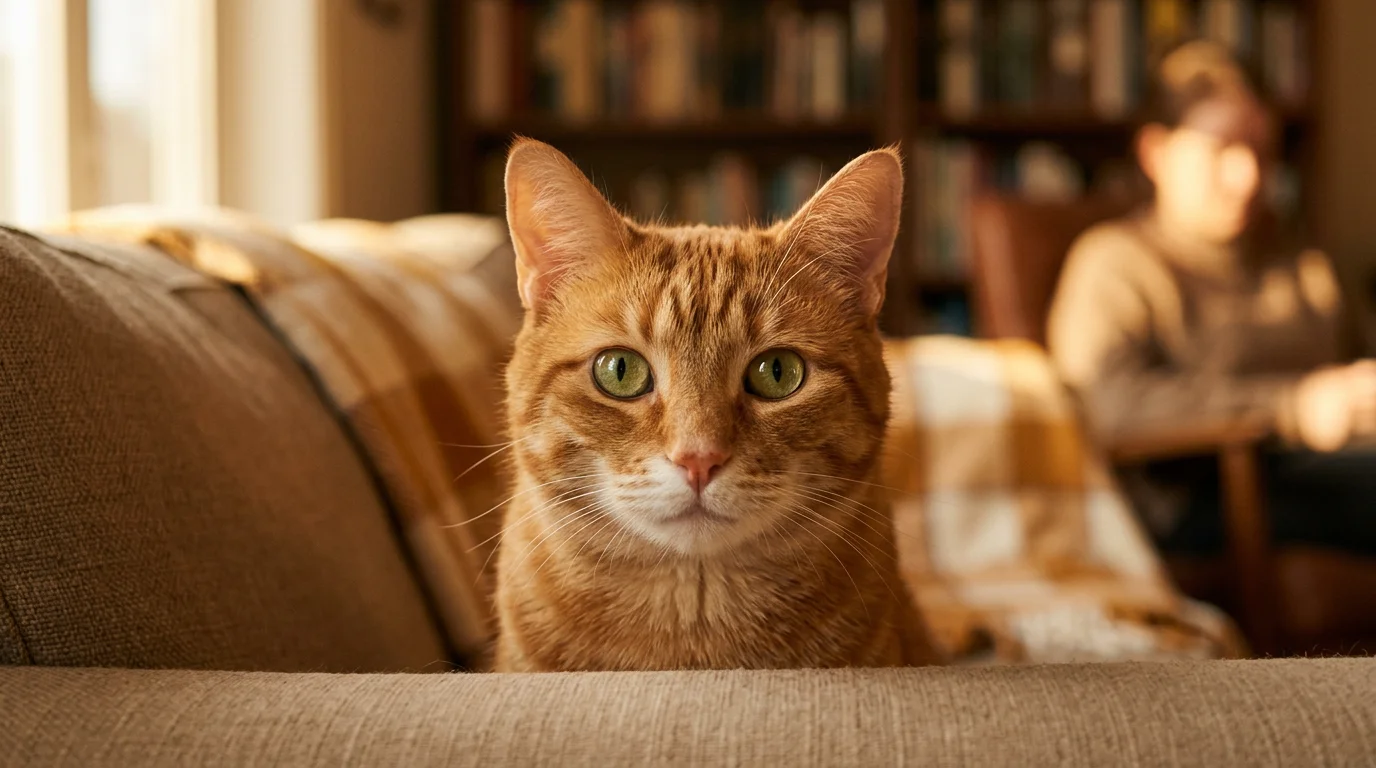
You walk through the door after a long day, and your cat trots over, tail held high, meowing in greeting. It certainly feels like recognition — but is it? Do cats actually recognize their owners, or are they simply responding to routine cues like the sound of keys or the time of day? The answer, according to a growing body of scientific research, is more fascinating than most cat owners expect. Cats do recognize their owners — but the way they do it reveals something remarkable about feline cognition.
How Do Cats Recognize Their Owners?
Cats are not primarily visual identifiers. Unlike humans, who rely heavily on facial recognition to distinguish individuals, cats use a multimodal recognition system — a combination of smell, sound, and visual cues that together form a reliable identity profile. This is an evolutionary adaptation: in the wild, felines must identify allies, threats, and territory markers across varying light conditions and distances, making a single-sense approach unreliable.
Think of it this way: when your cat identifies you, they are cross-referencing multiple sensory inputs simultaneously. Your scent profile, the specific frequency and cadence of your voice, your movement patterns, and your general visual silhouette all contribute to a composite "you" in your cat's mind. This multimodal approach is actually more robust than relying on sight alone — which is why your cat knows it's you even in a dark room.
The Role of Smell, Sound, and Sight in Cat Recognition
Smell: The Primary Identifier
A cat's sense of smell is roughly 14 times stronger than a human's, with approximately 200 million olfactory receptors compared to our 5 million. Scent is the dominant sense cats use for identification. Every person has a unique scent signature — a combination of skin bacteria, diet, personal care products, and pheromones — and your cat has memorized yours. This is why cats often sniff guests carefully and may take days to warm up to new people: they're building a scent profile from scratch.
Cats also use scent-marking behaviors like head-butting (bunting) and cheek rubbing to deposit their own pheromones on their owners. This isn't just affection — it's a territorial claim that says "this human is part of my colony." When your cat rubs against you, they're reinforcing the shared scent bond that helps them recognize you. This behavior is closely tied to the slow blink and other bonding signals that cats use to communicate trust.
Sound: The Voice They Know
A landmark 2013 study from the University of Tokyo demonstrated that cats can clearly distinguish their owner's voice from strangers' voices. In the experiment, cats were played recordings of their owners and unfamiliar people calling their names. The cats showed measurable responses — ear twitching, head movements, pupil dilation — when hearing their owner's voice, but showed significantly reduced responses to strangers.
Interestingly, the cats rarely vocalized or moved toward the sound source, which the researchers interpreted not as indifference but as a distinctly feline response style. Cats evolved as solitary hunters, not pack animals, so they lack the instinct to come when called. They absolutely recognize the voice — they simply choose how (and whether) to respond. A 2022 follow-up study from Paris Nanterre University further confirmed that cats can even distinguish "cat-directed speech" (the high-pitched tone owners use with their cats) from normal speech — but only when it comes from their own owner.
Sight: Recognizing Shapes, Not Faces
Visual recognition is where things get surprising. Cats have excellent motion detection and impressive low-light vision, but their visual acuity for detail — especially at close range — is relatively poor compared to humans. Cat visual acuity is estimated at 20/100 to 20/200, meaning what a human sees clearly at 100-200 feet, a cat needs to be at 20 feet to see with the same clarity.
This limited detail vision means cats likely don't recognize owners by fine facial features the way humans do. Instead, they rely on overall body shape, gait, size, and movement patterns. Your cat recognizes your silhouette walking down the hallway long before they can make out the details of your face. Combined with their dichromatic color vision, cats perceive their owners as familiar-shaped, familiar-moving figures rather than detailed portraits.
What Science Says About Cat Facial Recognition
A 2005 study from the University of Texas at Dallas tested whether cats could distinguish their owner's face from a stranger's face using photographs. The results were revealing: cats correctly identified their owner's face only about 54% of the time — barely above chance. In contrast, they identified familiar cat faces with about 91% accuracy.
This doesn't mean cats can't recognize their owners — it means they don't rely on facial features to do so. When stripped of scent, sound, and movement cues (as in a still photograph), cats struggle. But in real-world conditions, where all sensory channels are available, recognition is swift and reliable. The study actually tells us something important: cats have evolved a recognition system optimized for their ecological niche, not ours. They don't need to read human faces — they need to identify individuals across diverse conditions, and their multimodal system does exactly that.
Can Cats Recognize Their Owners After a Long Time Apart?
Cats possess impressive long-term memory, particularly for experiences with strong emotional or survival significance. While no definitive study has tested the upper limit of owner recognition after separation, feline long-term memory is estimated to last years — potentially a lifetime for significant relationships.
Anecdotal evidence from veterinarians and animal shelters consistently reports that cats reunited with owners after months or even years apart show clear recognition behaviors: immediate purring, head-butting, kneading, and the characteristic slow blink. These aren't behaviors cats display with strangers. The recognition likely persists because cats store identity information across multiple memory systems — olfactory memory (scent), auditory memory (voice), and procedural memory (routines and interactions). Even if one channel fades, others may trigger recall.
However, it's worth noting that your scent will have changed during a long separation. Your cat may need a brief re-familiarization period — a few sniffs and cautious observation — before fully relaxing into their recognition of you. This isn't uncertainty about who you are; it's the cat's sensory system updating its scent profile to match the voice and visual cues it already recognizes.
Do Cats Prefer Their Owners Over Strangers?
A 2017 study published in Behavioural Processes tested cat preferences by offering them four categories of stimuli: food, toys, scent, and human social interaction. The results surprised many: the majority of cats chose human social interaction over all other categories, including food. This strongly suggests that cats don't just recognize their owners — they actively prefer their company.
Further research from Oregon State University in 2019, using the "secure base test" adapted from human infant attachment studies, found that approximately 65% of cats display secure attachment to their owners. These cats used their owner as a "safe base" from which to explore unfamiliar environments — showing reduced stress and increased exploratory behavior when their owner was present versus absent. This attachment pattern closely mirrors the 65% secure attachment rate found in human infants, suggesting that the cat-human bond is deeper than previously assumed.
How CatLens Shows You the World Through Your Cat's Eyes
Understanding how your cat recognizes you starts with understanding how they see. CatLens transforms your phone's camera into a real-time cat vision simulator, showing you exactly what your cat perceives when they look at you. Our scientifically-calibrated filters simulate feline dichromatic color vision, reduced visual acuity, and enhanced peripheral awareness.
Point CatLens at yourself in a mirror and see what your cat sees: not the fine details of your face, but your overall shape, movement, and the muted color palette of your clothing. Then turn down the lights and watch how your silhouette becomes clearer as the simulation shifts to the cat's superior low-light mode. It's a powerful reminder that your cat's world — and their experience of you — is fundamentally different from what you imagine.
Frequently Asked Questions
Do cats miss their owners?
Yes, studies suggest cats do miss their owners. Research published in Current Biology found that cats form secure attachments to their caregivers, similar to dogs and human infants. Cats may show signs of separation anxiety such as excessive vocalization, changes in eating habits, or increased clinginess when their owner returns after a prolonged absence.
Can cats recognize voices?
Yes, cats can recognize their owner's voice. A 2013 study from the University of Tokyo showed that cats can distinguish their owner's voice from a stranger's voice, even without visual cues. Cats responded with ear and head movements when hearing their owner's voice, though they often chose not to respond overtly — a behavior consistent with feline independence rather than a lack of recognition.
Do cats remember past owners?
Cats likely retain long-term memories of past owners, especially if the bond was strong. Feline long-term memory can last for years, and cats primarily remember people through scent and vocal associations. Rehomed cats may show signs of recognition — such as purring, head-butting, or relaxed body language — when reunited with a former owner, even after months or years apart.
Related Articles
The slow blink is how cats say 'I love you.' Learn the science behind this behavior and how to slow blink back at your cat.
Read MoreHow do cats see the world? Learn the complete science of feline vision — from dichromatic color perception and UV light detection to superior night vision and 200° field of view.
Read MoreWhat colors can cats see? Cats have dichromatic vision with 2 cone types, seeing blues and yellows vividly while reds appear grayish-brown. Learn the full science of cat color perception.
Read More