Why Do Cats Stare at Nothing? 7 Reasons Explained
Your cat isn't seeing ghosts. Science reveals 7 reasons cats stare at empty spaces — from ultrasonic hearing to UV light detection.
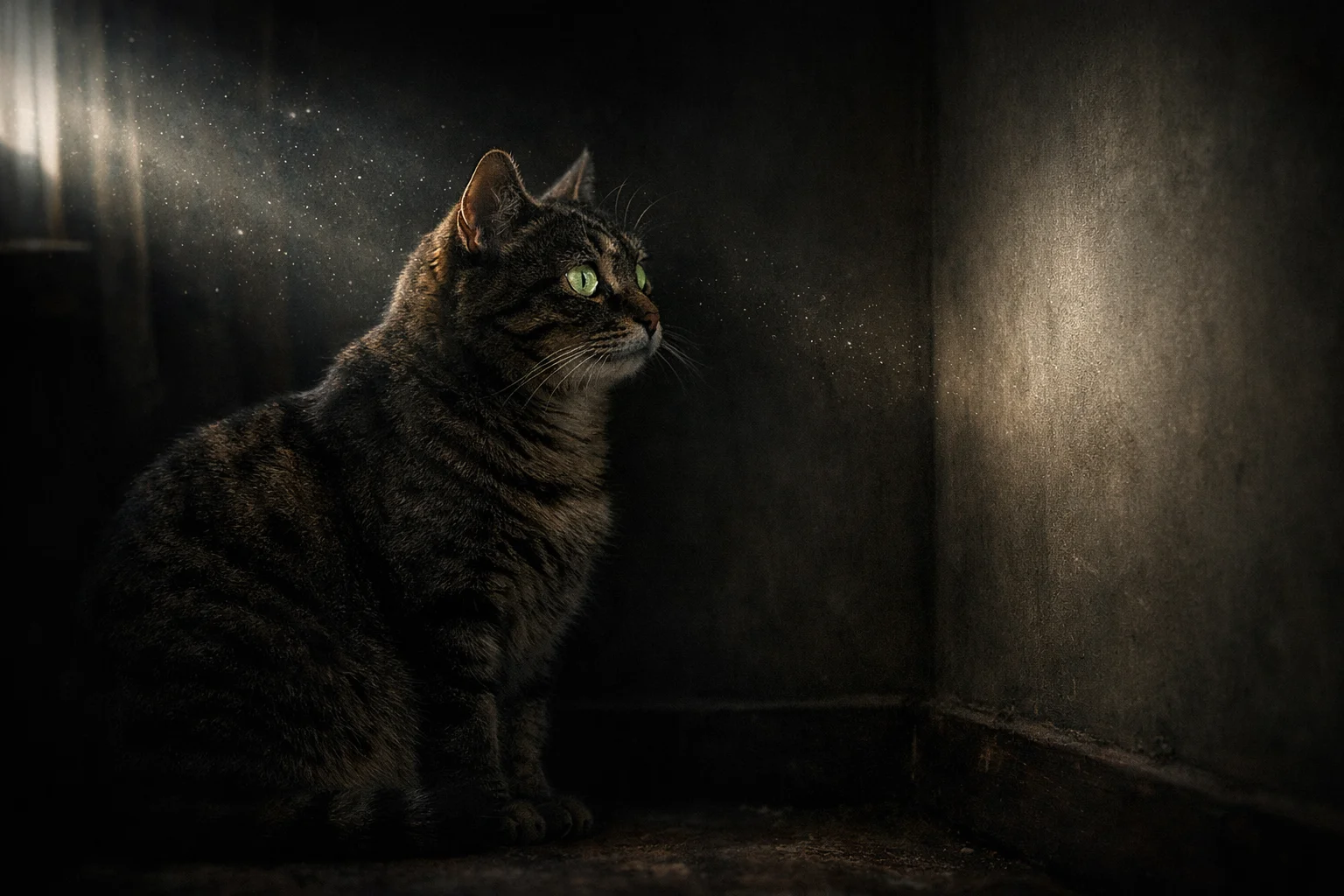
Why Does My Cat Stare at the Wall? (The Short Answer)
If you've ever caught your cat staring at a blank wall, an empty corner, or a spot on the ceiling where there's absolutely nothing, you're not alone. It's one of the most common — and most unnerving — behaviors cat owners report. But here's the short answer to why cats stare at nothing: they're not staring at nothing. They're detecting stimuli that your human senses simply cannot perceive.
Cats possess a sensory toolkit that far exceeds our own. Their eyes detect ultraviolet light invisible to humans. Their ears pick up ultrasonic frequencies we'll never hear. Their whiskers sense air currents too subtle for our skin to register. When your cat freezes and locks their gaze on an empty space, they're processing real information from the environment — information that is genuinely invisible to you. The science behind why cats stare at nothing reveals just how different their perception of the world truly is.
Cat Vision vs Human Vision — What They See That We Don't
The first key to understanding cat staring at wall behavior lies in their extraordinary visual system. Cat eyes are fundamentally different from human eyes in several critical ways, and these differences mean cats see things in your home that are literally invisible to you.
Cats have a much higher density of rod cells in their retinas — approximately 25 times more rods per square millimeter than humans in some retinal areas. Rod cells are responsible for detecting motion and light in low-light conditions. This means cats can detect extremely subtle movements — a tiny spider crawling along the baseboard, a shadow shifting as clouds pass outside, or the faint flicker of light reflecting off a dust particle — that would be completely invisible to human eyes. For an in-depth look at how feline vision works, see our guide on how cats see the world.
Perhaps most remarkably, a 2014 study published in Proceedings of the Royal Society B confirmed that cats can see ultraviolet light. Their lenses transmit UV-A wavelengths (315-400nm) that the human lens blocks entirely. This means your cat sees UV-fluorescent patterns on walls, fabrics, and surfaces that are completely invisible to you. Detergent residues, certain paint compounds, and even biological traces like old urine marks fluoresce under UV — creating a visual landscape your cat can see but you cannot. We explore this hidden world in detail in our article on things only visible to cats.
Cats also have a reflective layer behind their retinas called the tapetum lucidum, which bounces light back through the retinal cells for a second pass. This effectively doubles the light available for vision, giving cats exceptional night vision and the ability to see details in near-total darkness that would be pitch black to us. A faint shadow, a subtle light shift, or a tiny reflection that you'd never notice can be perfectly clear to your cat.
Ultrasonic Hearing — Sounds Beyond Human Range
Vision is only part of the story. Cats possess one of the broadest hearing ranges of any domestic animal, and this plays a major role in why cats stare at nothing. Human hearing tops out at roughly 20 kHz. Cats can hear sounds up to approximately 85 kHz — more than four times our upper limit. This places an enormous range of sounds in the "ultrasonic" category: sounds that physically exist in your environment but that your ears are biologically incapable of detecting.
What produces ultrasonic sounds in a typical home? More than you might think. Rodents communicate extensively in the ultrasonic range (30-110 kHz), producing calls, mating signals, and distress sounds that are completely silent to human ears but loud and clear to your cat. Insects generate ultrasonic vibrations — a beetle larvae chewing through wood in your wall creates sounds at frequencies well above 20 kHz. Even household electronics emit high-frequency sounds: older CRT televisions, some LED drivers, charging devices, and certain appliances produce ultrasonic noise.
When your cat suddenly turns their head and stares fixedly at a specific spot on the wall, they may be tracking a mouse or insect behind the drywall that you cannot hear. Their ears can rotate independently up to 180 degrees, functioning like biological satellite dishes to pinpoint the exact location of a sound source. This directional hearing is so precise that a cat can locate a sound source to within 5 degrees — giving them the ability to stare at the exact spot where the stimulus originates.
Research at the University of Tokyo found that cats also have excellent auditory memory and can distinguish their owner's voice from strangers even in recordings. This sophisticated auditory processing means your cat isn't just hearing sounds — they're analyzing, categorizing, and locating them with remarkable precision, which is closely related to other extraordinary sensory abilities cats possess.
The Role of Whiskers in Detecting Air Currents
Cat whiskers (vibrissae) are not just facial decorations — they are sophisticated sensory organs embedded three times deeper in the skin than regular hairs, surrounded by nerve-rich follicles that detect incredibly subtle changes in air pressure and movement. Each whisker is connected to approximately 100-200 nerve cells at its base, making them exquisitely sensitive tactile instruments.
In a closed room, air currents move in complex patterns caused by HVAC systems, windows, temperature differentials between surfaces, and even the movement of insects or small animals. These micro-currents are completely imperceptible to human skin, but a cat's whiskers can detect air movements as slight as 2 mm/s. When your cat stares at an empty corner, they may be sensing disturbed air currents caused by a draft from a crack you didn't know existed, an insect moving behind furniture, or warm air rising from an electronic device.
Whiskers also help cats build a spatial map of their environment. They can detect objects and barriers without touching them by sensing how air flows around surfaces. This means your cat is constantly receiving tactile information about the room that supplements what they see and hear — creating a three-dimensional sensory picture that is far more detailed than what any human could construct from the same environment.
Can Cats See Ghosts? (The Science Behind the Myth)
The idea that cats can see ghosts or spirits is one of the oldest and most persistent myths about feline behavior. It's easy to see why: watching your cat stare intently at an empty room, pupils dilated, ears forward, sometimes even hissing or growling at seemingly nothing, is genuinely unsettling. Across cultures, from ancient Egypt to medieval Europe to modern Japan, cats have been associated with the supernatural.
However, science provides a much simpler and more compelling explanation. Every behavior attributed to "ghost sensing" can be explained by cats' documented sensory superiority. That fixed stare at an empty corner? UV-fluorescent traces on the wall, a tiny insect imperceptible to humans, or reflected light only visible to their more sensitive eyes. The sudden hiss at nothing? An ultrasonic sound from a rodent in the wall or a high-frequency electronic noise. The fur standing on end? A subtle air pressure change detected by whiskers that precedes a weather front or signals a draft.
A 2013 study in Animal Cognition demonstrated that cats can track invisible objects using sound alone — they form mental representations of things they can hear but not see. When a cat stares at a spot where they hear an ultrasonic sound, they're not seeing a ghost — they're looking at exactly where their ears tell them something physically exists, even though that something is hidden from both their sight and your entire sensory range.
When Staring Could Signal a Health Problem
While most wall-staring is perfectly normal feline behavior driven by their superior senses, there are specific situations where staring can indicate a medical issue that requires veterinary attention. It's important to distinguish between normal sensory exploration and signs of neurological or cognitive problems.
Head pressing is the most important red flag. If your cat presses their forehead against the wall rather than simply staring at it, this can indicate serious neurological conditions including brain tumors, hepatic encephalopathy (liver disease affecting the brain), infections such as toxoplasmosis or feline infectious peritonitis (FIP), or toxic exposure. Head pressing is a recognized clinical sign that warrants immediate veterinary evaluation.
Feline cognitive dysfunction syndrome (CDS) affects an estimated 28% of cats aged 11-14 and over 50% of cats over 15. Symptoms include disorientation, confusion, staring blankly into space (without the alert, focused quality of normal sensory detection), changes in sleep-wake cycles, altered social behavior, and house soiling. If your senior cat stares at walls with a vacant expression, seems confused about where they are, or gets stuck in corners, a veterinary evaluation is important.
Hypertension (high blood pressure), often secondary to kidney disease or hyperthyroidism in older cats, can cause visual disturbances and unusual staring behaviors. Seizure activity, including partial seizures, can also manifest as fixed staring episodes sometimes accompanied by lip smacking, twitching, or brief unresponsiveness. If staring is accompanied by any of these signs, or if the behavior is new, sudden, and persistent, consult your veterinarian.
Experience What Your Cat Perceives with CatLens
Understanding why cats stare at nothing is fascinating — but seeing what they see is transformative. CatLens uses scientifically-calibrated visual filters to simulate cat perception on your phone's camera, letting you experience the world through your cat's eyes in real time.
Switch to UV mode to see the fluorescent patterns your cat detects on everyday surfaces. Enable the enhanced night vision filter to understand how your cat navigates in the dark. Use the motion detection overlay to visualize how your cat tracks movements you'd never notice. CatLens transforms abstract science into a tangible, visual experience that deepens your understanding of your cat's remarkable perception.
The next time your cat stares at an empty corner, open CatLens and point it at the same spot. You might be surprised by what your cat has been seeing all along — UV traces, light patterns, and visual details that are genuinely invisible to the naked human eye.
Frequently Asked Questions
Is my cat seeing spirits?
No — there is no scientific evidence that cats see ghosts or spirits. When your cat stares at seemingly empty spaces, they are detecting real physical stimuli beyond human perception: ultraviolet light patterns, ultrasonic sounds from insects or rodents in walls, or subtle air currents from drafts and HVAC systems. Cats have vastly superior sensory capabilities that explain these behaviors without requiring supernatural explanations.
Why does my cat stare at me?
A relaxed, slow-blinking stare is a sign of trust and affection — often called a "cat kiss." A wide-eyed, unblinking stare may indicate curiosity, a desire for food or attention, or mild anxiety. Cats stare at their owners to monitor body language and predict behavior. Unlike staring at walls (which involves detecting hidden stimuli), staring at you is social communication.
Should I worry if my cat stares at walls a lot?
Occasional wall-staring is completely normal. However, seek veterinary attention if your cat presses their head against the wall, appears disoriented or confused, shows sudden behavioral changes, or seems to be having seizures. In senior cats (11+), frequent vacant staring combined with disorientation could indicate cognitive dysfunction syndrome. When in doubt, a veterinary check-up provides peace of mind.
Do cats sense energy?
While "sensing energy" isn't scientifically defined, cats detect many forms of physical energy humans cannot: UV electromagnetic radiation through their eyes, sound energy up to 85 kHz through their ears, thermal energy through specialized nerve endings, and kinetic energy from air currents via their whiskers. They may also detect seismic vibrations before earthquakes. Cats don't sense mystical energy, but their biological sensors detect real physical phenomena invisible to humans.
Related Articles
Cats can see ultraviolet light that's invisible to humans. Discover 7 surprising things your cat sees every day that you completely miss.
Read MoreHow do cats see the world? Learn the complete science of feline vision — from dichromatic color perception and UV light detection to superior night vision and 200° field of view.
Read MoreScientists studied whether cats sense earthquakes before they happen. The evidence is more compelling than you'd expect.
Read More