7 Things Only Visible to Cats: The Hidden UV World
Cats can see ultraviolet light that's invisible to humans. Discover 7 surprising things your cat sees every day that you completely miss.
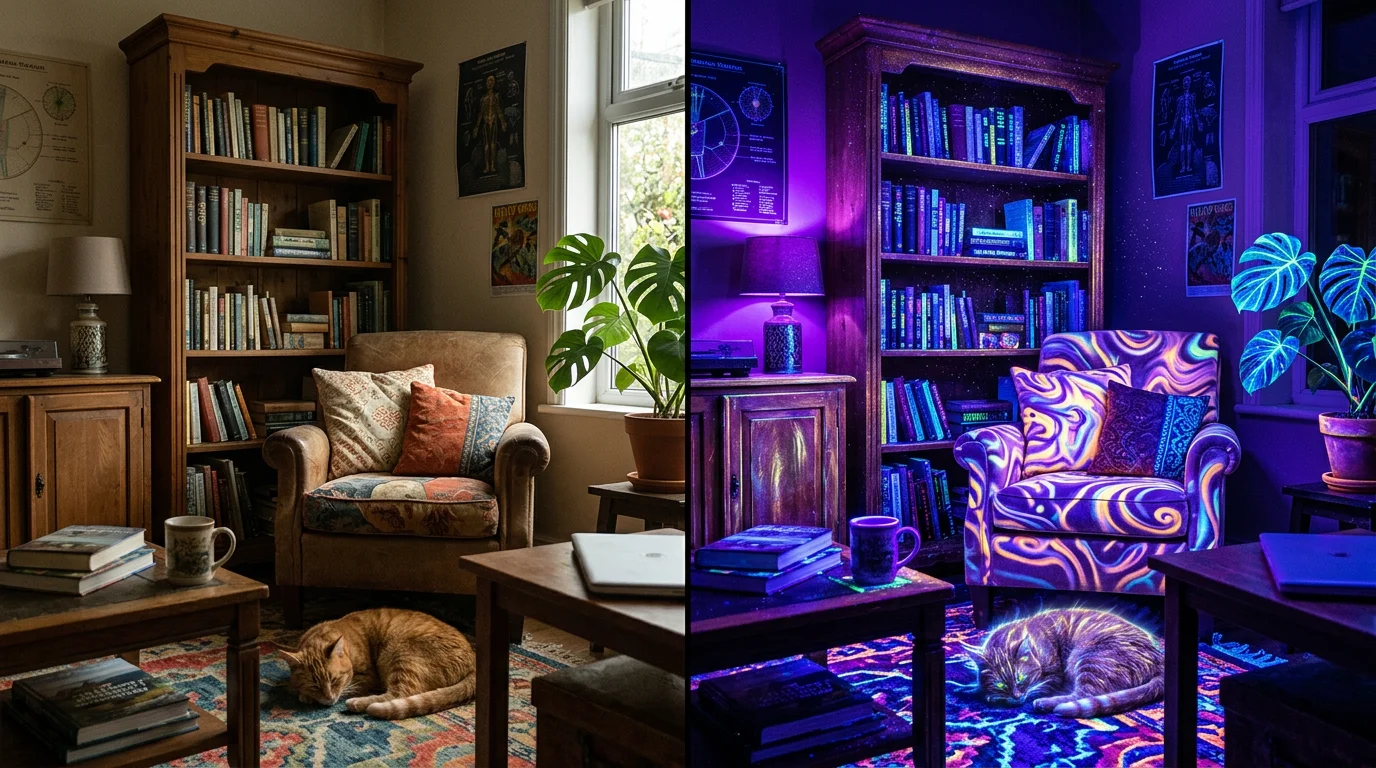
Cats See a Secret World We Can't
When you look around your living room, you see what visible light reveals — furniture, colors, shadows. But your cat sees more. A landmark 2014 study published in Proceedings of the Royal Society B confirmed that cats' lenses transmit ultraviolet light in the UV-A range (315-400nm), wavelengths that the human lens blocks entirely. This means cats perceive an entire layer of visual information that is literally invisible to us.
UV vision isn't a superpower — it's an evolutionary adaptation shared by many mammals. But in cats, combined with their already remarkable night vision capabilities, it creates a sensory world far richer than what we experience. Here are seven things your cat can see that you completely miss.
1. Urine Trails and Territory Marks
Cat urine fluoresces brightly under UV light. When your cat sprays or marks territory, those marks are invisible to your eyes within hours — but to another cat, they glow like neon signs. This is critical for feline communication: territory boundaries, mating status, and individual identity are all encoded in these UV-visible marks.
This is why your cat sometimes stares intently at seemingly blank walls or corners. They may be reading a message left by a previous animal — a glowing territorial signature that you literally cannot see. The UV fluorescence of urine comes from compounds like felinine, an amino acid unique to cat urine that breaks down into sulfur-containing molecules with strong UV-reflective properties.
2. UV Patterns on Flowers and Plants
Many flowers have evolved UV patterns — called "nectar guides" — to attract pollinating insects. These patterns are invisible to the human eye but create striking bullseye-like markings visible to any animal with UV sensitivity. Sunflowers, for example, display concentric UV-absorbing rings around their centers that look dramatically different under UV light.
To your cat, a garden isn't just green and colorful — it's a landscape of glowing patterns. Black-eyed Susans, daisies, and many wildflowers display bold UV contrasts that transform their appearance. While cats aren't interested in pollination, these patterns add visual complexity to their outdoor environment that we simply don't perceive. Understanding the full scope of what colors cats can see helps explain how UV adds another dimension to their visual world.
3. Rodent Urine Trails (Hunting Advantage)
Mice and rats urinate constantly as they move, leaving thin trails along their regular paths. These urine trails fluoresce under UV light, creating a literal glowing roadmap of rodent activity. For a hunting cat, this is invaluable intelligence — they can see exactly where prey has been and predict where it will go.
Research from the University of Liverpool demonstrated that kestrels (birds of prey with UV vision) use rodent urine trails to locate prey. Cats almost certainly use the same strategy. A fresh, brightly fluorescent trail means recent activity; a faded trail means the rodent hasn't been through in a while. Your cat isn't just sitting by the mouse hole hoping — they're reading UV-fluorescent tracking data in real time.
4. Subtle Fabric Patterns Invisible to Humans
Many modern fabrics contain optical brightening agents (OBAs) — chemicals that absorb UV light and re-emit it as visible blue-white light. This is what makes your "whites look whiter" in detergent commercials. To human eyes, the effect is subtle. To a cat's UV-sensitive eyes, treated fabrics literally glow.
This means your cat sees patterns on clothing, bedding, and upholstery that you don't. A plain white t-shirt might display bright patches where detergent residue is concentrated. Different fabrics glow with varying intensity depending on their treatment. Your cat's textile world is patterned and luminous in ways you've never imagined.
5. Certain Insects That Glow Under UV
Many arthropods fluoresce under UV light. Scorpions are the famous example — they glow bright blue-green under UV — but many common insects also have UV-fluorescent properties. Certain moth species, beetles, butterflies, and even some spiders reflect or fluoresce UV light, making them more visible to UV-sensitive predators.
For your cat, an insect that looks brown and camouflaged to you might stand out with a UV-reflective shimmer. This gives cats an edge when hunting insects indoors and outdoors. Combined with their superior motion detection abilities, UV vision makes cats remarkably efficient insect hunters — which is why that fly never escapes for long.
6. Skin Conditions and Health Markers on Other Animals
Certain skin conditions, fungal infections, and biological markers fluoresce under UV light. In veterinary medicine, Wood's lamp (a UV-A light source) is used to diagnose ringworm and other dermatological conditions because infected tissue glows under UV exposure. Cats can see these same UV fluorescent markers naturally.
This means cats might visually detect health conditions on other animals — and potentially on humans — that are invisible to our eyes. A cat that suddenly avoids another pet or reacts differently to a person might be responding to UV-visible changes in skin or fur that signal illness. While this hasn't been definitively proven as a conscious behavior, the visual information is available to them.
7. Paper Brighteners and Detergent Residues
Like fabrics, white paper is treated with optical brightening agents that fluoresce under UV light. To your cat, a sheet of white paper doesn't look like a flat, uniform surface — it glows. Books, newspapers, mail, and paper towels all emit visible fluorescence that cats can see. This also explains why some cats are oddly attracted to sitting on paper or documents.
Similarly, surfaces cleaned with detergent or bleach leave UV-fluorescent residues. Your freshly cleaned kitchen counter has a UV glow that fades over time. Your cat can see how recently a surface was cleaned by the intensity of its fluorescence — a distinction completely invisible to human eyes. The differences between cat, dog, and human vision extend far beyond color perception into these hidden UV dimensions.
Why Can Cats See UV Light?
The answer lies in the lens. Human lenses contain UV-absorbing pigments (primarily kynurenine and its derivatives) that filter out UV wavelengths before they reach the retina. This protects our retinas from UV damage but blocks an entire spectrum of visual information. Cat lenses lack these UV-absorbing pigments, allowing UV-A light to pass through and stimulate their retinal cells.
The 2014 study by Douglas and Jeffery measured lens transmission across 38 mammalian species and found significant variation. Cats, dogs, hedgehogs, and many rodents all transmit UV light, while humans and other primates block it. The researchers hypothesize that UV-blocking lenses evolved in primates to improve visual acuity — UV light scatters more than visible light, so filtering it out produces sharper images. Cats traded some sharpness for a broader spectral range, which proved more valuable for their crepuscular hunting lifestyle.
Interestingly, humans who undergo cataract surgery (which replaces the natural lens with an artificial one) sometimes report seeing UV fluorescence, confirming that our retinas can detect UV — it's our lenses that block it. The famous painter Claude Monet reportedly experienced this after his cataract surgery in 1923, describing new blue-purple colors that others couldn't see.
Experience Your Cat's UV Vision with CatLens
Reading about UV vision is one thing — seeing it is another. CatLens lets you switch to UV mode and experience the world as your cat sees it, with ultraviolet highlights on everyday objects. Point your camera at white paper, laundry, or your garden and watch the hidden UV world light up on your screen.
The next time your cat stares at an empty wall or pounces on an invisible target, remember: they're not seeing nothing. They're seeing something you can't. With CatLens, you can finally glimpse the hidden ultraviolet world your cat lives in every day.
Frequently Asked Questions
Do all cats see UV?
Yes. UV-transmitting lenses are a universal feature of domestic cats, not limited to specific breeds. The 2014 study by Douglas and Jeffery confirmed this across all tested felid species. Every cat you've ever met sees UV light that you cannot.
Can UV vision hurt cats?
Under normal environmental conditions, no. Cats evolved with UV-transmitting lenses and their retinas are adapted to handle the UV-A light that passes through. However, artificial UV sources like UV sterilization lamps can be harmful — keep your cat away from direct exposure to strong UV devices, just as you would protect your own eyes.
Do dogs also see UV?
Yes, dogs also have UV-transmitting lenses and can perceive ultraviolet light. The same study found UV transmission in dogs, hedgehogs, ferrets, and many other mammals. Among common pets, both cats and dogs see UV — it's actually humans (and other primates) who are the odd ones out, with lenses that block UV to improve image sharpness.
Related Articles
How do cats see the world? Learn the complete science of feline vision — from dichromatic color perception and UV light detection to superior night vision and 200° field of view.
Read MoreWhat colors can cats see? Cats have dichromatic vision with 2 cone types, seeing blues and yellows vividly while reds appear grayish-brown. Learn the full science of cat color perception.
Read MoreCompare how cats, dogs, and humans see the world. Surprising differences in color, night vision, and motion detection explained.
Read More