What Colors Can Cats See? The Science Behind Cat Color Vision
What colors can cats see? Cats have dichromatic vision with 2 cone types, seeing blues and yellows vividly while reds appear grayish-brown. Learn the full science of cat color perception.
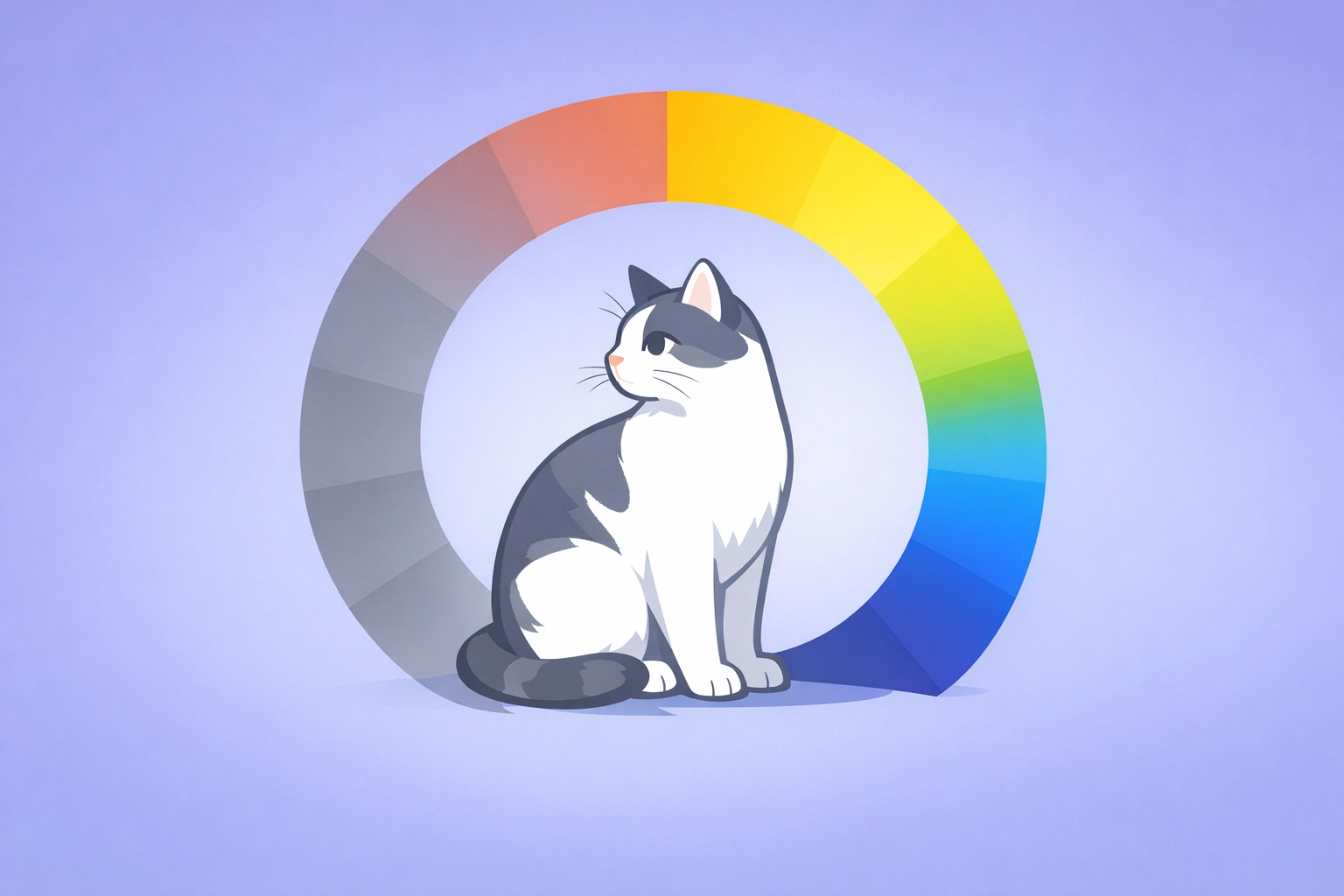
"Can cats see color?" is one of the most common questions cat owners ask. The short answer is yes — but not the way you do. For decades, the myth that cats see only in black and white persisted. Modern research has conclusively debunked this, revealing a color world that's more subtle and nuanced than ours, but far from monochrome. Let's explore exactly what your cat sees when they look at the world around them.
The Dichromatic Color System: How It Works
Color vision depends on specialized cells in the retina called cone cells. Each cone type is sensitive to a different range of light wavelengths. The number and type of cones determines the color gamut an animal can perceive:
- Humans (trichromats): Three cone types — S-cones (blue, ~420nm), M-cones (green, ~530nm), and L-cones (red, ~560nm). This trio allows us to see roughly 10 million color combinations.
- Cats (dichromats): Two cone types — S-cones (blue, ~450nm) and M-cones (green, ~555nm). Without L-cones, cats are missing the entire red end of the visible spectrum. They can distinguish roughly 10,000-100,000 colors.
The cat's dichromatic system is analogous to human deuteranopia (red-green color blindness), a condition affecting about 8% of human males. If you've ever used a color blindness simulator, that's a reasonable approximation of cat color vision — though cat vision also differs in saturation and brightness. For a broader comparison, see our cat vs dog vs human vision comparison.
Colors Cats See Well
Not all colors are equal in a cat's world. Here are the colors that stand out most to feline eyes:
Blue (400-490nm)
Blue is the single most vivid color in a cat's visual spectrum. Their S-cones peak at approximately 450nm, right in the blue range, making blues appear nearly as vivid to cats as they do to humans. A bright blue toy against a brown carpet practically screams for attention in cat vision. This is why blue toys outperform red ones every time.
Yellow and Yellow-Green (530-580nm)
Yellows fall within the sensitivity range of cat M-cones and appear as a distinct hue, though less vivid than blue. Yellow-green shades register well because they stimulate the M-cones effectively. A bright yellow ball on gray tile creates strong visual contrast for a cat.
Violet and Purple (380-450nm)
Since purple contains blue wavelengths, cats perceive it relatively well — it appears as a shade of blue to them. Violet/purple toys are a good alternative to pure blue and equally visible to feline eyes.
Colors Cats Struggle to See
Without L-cones (red-sensitive), cats are effectively blind to the warm end of the color spectrum:
Red (620-700nm)
Red light falls entirely outside the sensitivity range of both cat cone types. To a cat, a red object appears as a dark grayish-brown. A bright red toy on a brown floor is practically invisible. This is why that expensive red mouse sits untouched while the cheap blue feather gets demolished.
Orange (590-620nm)
Orange partially stimulates M-cones, so it isn't completely invisible, but it appears as a dull, desaturated yellowish-brown. Much of the vibrancy is lost. An orange tabby cat appears far less colorful to another cat than to us.
Green (500-565nm)
Greens fall within M-cone range, so cats can detect them — but without the red-green discrimination that L-cones provide, greens appear as muted yellows or brownish tones. A lush green lawn looks more like a field of dull yellowish-gray to a cat.
Pink (Red + White)
Since pink is essentially a lighter shade of red, it appears as a pale bluish-gray to cats. That cute pink collar you bought? Your cat sees it as a neutral, washed-out tone.
Color Saturation: The Muted World
Beyond the reduced color range, cats see all colors with lower saturation than humans. Even blues and yellows, which cats can detect, appear less vivid — roughly 50% less saturated compared to human perception. Imagine watching a movie with the saturation slider pulled halfway down. That's closer to the cat experience.
This reduced saturation is a direct consequence of having fewer cone cells overall. Cats compensate with approximately 25 rod cells for every cone cell, giving them extraordinary light sensitivity and motion detection at the cost of color richness. It's an evolutionary trade-off: a nocturnal hunter needs to see movement in darkness more than it needs to distinguish shades of red from orange. Learn more about this in our complete guide to how cats see the world.
The Hidden Spectrum: UV Light
While cats see fewer colors in the visible spectrum, they have an unexpected advantage: UV vision. Research has shown that cat lenses transmit UV-A light (315-400nm) that human lenses block entirely. This means cats can see ultraviolet patterns on flowers, UV-fluorescent urine trails from rodents, and other biological markings invisible to us.
So while your cat's world has fewer colors in the red-green range, it extends into an ultraviolet dimension that we literally cannot see. Their color world isn't just "less" than ours — it's fundamentally different.
The Science Behind CatLens: How We Simulate Cat Color Vision
CatLens doesn't just apply a simple color filter. Our app uses a scientifically-calibrated pipeline built on WebGL shaders that process your camera feed in real-time:
- Spectral Sensitivity Mapping: We use published data on feline cone cell spectral sensitivity curves (Loop et al., 1987; Ringo et al., 1977) to build a color transformation matrix. This matrix converts trichromatic RGB input into a dichromatic approximation matching the cat's S-cone (~450nm) and M-cone (~555nm) response.
- Saturation Reduction: We reduce color saturation by approximately 50% to match the lower cone density in the feline retina, producing the muted color palette cats experience.
- Brightness Enhancement: The simulation boosts brightness to approximate the tapetum lucidum's light amplification effect and the cat's larger pupil diameter.
- Contrast Adjustment: Cats have lower contrast sensitivity than humans, so we apply a subtle contrast curve adjustment to match measured feline contrast sensitivity functions.
The result is a real-time, scientifically-grounded approximation of feline color vision. It's not a gimmick — it's based on decades of peer-reviewed research in comparative visual neuroscience.
Practical Tips: Living in Your Cat's Color World
- Toys: Buy blue and yellow toys. Avoid red, orange, and pink. Your cat will engage more with colors they can actually see.
- Food bowls: Blue or yellow bowls create visual contrast against most foods, making it easier for your cat to see their meal.
- Beds and blankets: Cats don't choose beds by color, but if you want your cat to spot a new bed quickly, blue stands out most in their vision.
- Play environment: Create contrast. A blue toy on a brown floor pops; a red toy on the same floor vanishes. Think about color contrast from your cat's perspective, not yours.
- Outdoor time: Remember that your cat sees your garden very differently — the green grass appears dull yellow-gray, while the sky remains a vivid blue. Their world is dominated by blues, yellows, and grays.
See Through Your Cat's Eyes
The best way to understand cat color vision isn't reading about it — it's experiencing it. Download CatLens and point your camera at anything: your cat's toys, your living room, your garden. Watch the world transform as reds fade to gray, blues remain vivid, and you suddenly understand why your cat makes the choices they do.
Try pointing CatLens at a red and blue toy side by side. In your vision, both are equally colorful. In your cat's vision? The blue toy pops while the red one nearly disappears. That single comparison will change how you shop for your cat forever.
Related Articles
Why does your cat ignore red toys? The science of dichromatic cat vision explains it. Learn which toy colors cats see best — blue, yellow — and how to pick toys they'll actually chase.
Read MoreHow do cats see the world? Learn the complete science of feline vision — from dichromatic color perception and UV light detection to superior night vision and 200° field of view.
Read MoreCompare how cats, dogs, and humans see the world. Surprising differences in color, night vision, and motion detection explained.
Read More